Types of Elevators in Buildings: How to Choose the Right Solution
Types of Elevators in Buildings that can be installed in construction projects vary with reference to the aim of construction, space, passengers’ needs, as well as use. Whether elevators are installed in residences, apartments, hospitals, or offices, it is nécessaire to choose the right option to make it easier for people to use these lifts. Each lift type has its own advantages and disadvantages, so choosing the right option may take some time. Understanding the types of elevators in buildings can help property owners make a suitable choice.
5 Common Types of Elevators in Buildings
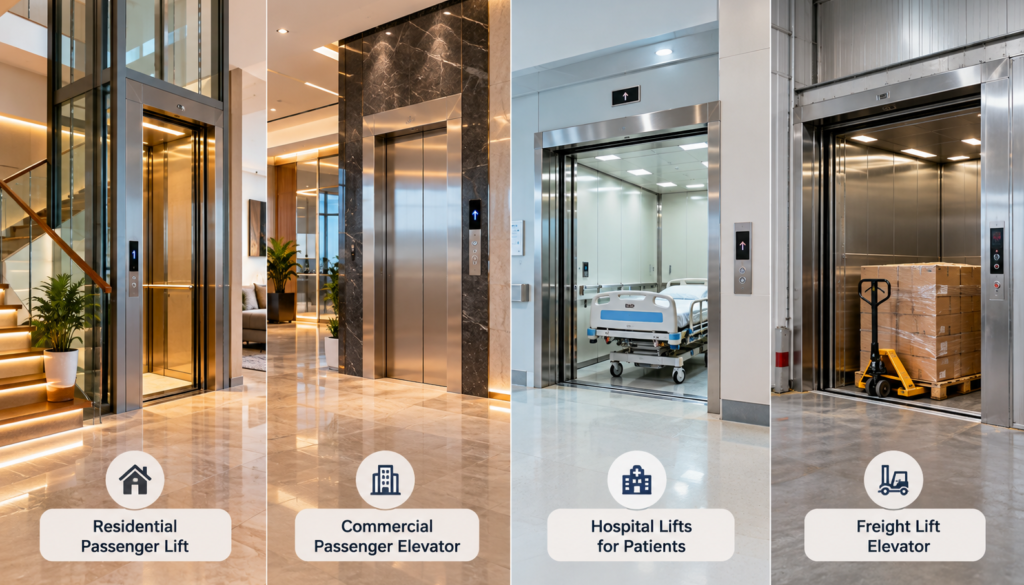
1. Residential Passenger Lifts
The residential passenger lift is meant to allow people to get from one floor to another in their homes or apartments. This means that the elevator is useful for aged people, people with mobility limitations, and families occupying several floors of a building. A residential passenger lift can make daily movement more convenient for homeowners.
There are various types of residential lifts on the market today. When selecting the most suitable lift for your home, consider, among other things, the number of floors, available shaft space, number of passengers, safety and maintenance requirements.
2. Commercial Passenger Elevators
Commercial passenger lifts are usually found in buildings like offices, hotels, and shopping malls where there are high levels of foot traffic. Passenger lifts usually have different capacities depending on how busy the building is.
Some points that determine the right type of lift include the height of the building, its expected traffic, speed of travel, and the time taken to receive the lift. Buildings that have frequent movement of passengers will need a lift that meets the peak traffic demands. These considerations are important when comparing the types of elevators in buildings for commercial use.
3. Hospital Lifts for Patients
Lift systems for medical patients are built for transportation of patients, including moving on hospital beds and litters whenever needed. Used in hospitals, clinics, and other health care setups, these systems usually necessitate the existence of an appropriate cabin size, smooth operation of lift equipment, size of doors, and safety features of the apparatus. As for the power supply scheme for the elevator systems and proper maintenance services, these aspects also need to be taken into consideration depending on the particular arrangements. Choosing suitable hospital lifts for patients is essential for safe and convenient transportation.
If a lift system at the hospital is to be designed and installed, it is better to refer to a specialist in this field of activity to figure out the necessary parameters and characteristics that should be met.
4. Freight Lift Elevators
A freight elevator is specifically created to move freight, commodities, and heavy items between levels. This type of elevator finds its application at factories, warehouses, hotels, restaurants, and industrial enterprises. A freight lift elevator should be selected according to the building’s loading and transportation requirements.
In order to pick the right elevator, assess its maximum capacity (load), dimensions of the items that will be moved, loading methods, number of floors, and the use frequency. Choosing to employ an elevator with the right capacity ensures effective activities related to good handling as well as minimizes the danger of overloading and exceeding the device capacity.
Do not forget that freight elevators must be selected based on their application and cannot be used to transport passengers unless stated otherwise.
5. Machine Room Less (MRL) Elevators
MRL (Machine Room Less) elevators operate without having an associated machine room. The various components of the drive system are usually positioned in the elevator shaft or in other spaces, depending on the MRL elevator type.
MRL elevator systems can be used in residential buildings and commercial buildings in case the space must be used efficiently. However, the dimensions of the required shaft, clearance, access for maintenance, and requirements of the building must be considered prior to installation.
How to Choose the Right Elevator for Your Building
Choosing the right option involves more than just cost. Here are some important factors to take into account before making a decision. Purpose for building: Identify if the elevator is meant for residents, visitors, patients, or goods. Passenger/load capacity: Select a system that fulfills the requirements of intended use. Comparing the types of elevators in buildings can help building owners identify a suitable option.
Conclusion
Different types of elevators in buildings help stakeholders in choosing the right elevator according to their area, usage, and safety standards. Be it a residential passenger elevator, a hospital elevator, a freight elevator, or a commercial passenger elevator, it is important to plan and take the necessary advice.
If you are looking for the right elevator options for your building, visit Axirise Elevators to review options and discuss your requirements with field experts.